There is a particular age at which arriving in Britain goes badly for your education, and it is not the age most people expect. It is not five, and it is not eleven. It is fifteen, sixteen, seventeen — the years in which the English school system stops being a place you are simply enrolled in and starts being a series of gates, each one requiring a qualification you were never in the country to sit.
We run a free STEM summer school at University College London and a year-round online mentoring scheme, both for young people from refugee, asylum-seeking and forced-migrant backgrounds. Over eight years we have worked with students from more than twenty countries. Almost every one of them arrived inside that window. And almost every one of them described the same thing: not hostility, exactly, and not always neglect — but a system with no obvious slot for them, and no one whose job it was to find one.
Our volunteers have a name for it, borrowed from the students themselves. The GCSE vacuum.
- of young people with the lowest family incomes achieve a good pass in their GCSEs
- 21%of young people with the lowest family incomes achieve a good pass in their GCSEsCompared with 75% of students from the highest-income households
- of young people on free school meals enter higher education
- 26%of young people on free school meals enter higher educationCompared with 43% of their peers
- is the statutory target for finding a school place
- 20 daysis the statutory target for finding a school placeIn 2018 not a single UK region met it for the unaccompanied children in its care
This article sets out what the vacuum is actually made of — the five separate mechanisms that combine into it — and what the evidence says about closing it. It draws on published statistics, on the work of organisations such as the Refugee Council and Refugee Education UK, and on our own programme records from 2018 to 2025.
What the vacuum is
Picture a sixteen-year-old who reaches the UK in October. She has ten years of schooling behind her, taught in Tigrinya or Dari or Arabic. She is bright — bright enough that her science teacher back home entered her for competitions. She speaks some English, learned from film subtitles and a phone app.
In the country she left, she was two years from a school-leaving certificate. In England, she is four months from the start of a GCSE exam series she has not been taught for, in a language she is still acquiring, in a subject vocabulary that no general English course covers. She will not sit those exams. And because she will not sit them, the door to sixth form, to a Level 3 BTEC, to an apprenticeship, and eventually to a university application, is closed — not by a decision anyone made about her, but by the shape of the system.
That is the vacuum. It is not one barrier. It is five, stacked.
Barrier one: getting into a school at all
Before any of the curriculum questions arise, there is the question of whether a young person is in a classroom.
Local authorities have a duty to find school places for the children in their care, and the working target has long been twenty school days. For unaccompanied asylum-seeking children, that target is missed routinely. A 2018 analysis found that no region of the UK met the twenty-day target for the unaccompanied children in its care — not one.
Delay compounds in a way that is easy to underestimate. A term lost at fourteen is a term of vocabulary, of friendships, of the ambient exposure that makes a language stick. It is also a term in which a young person learns, correctly, that the system is not expecting them.
And the closer to sixteen a young person arrives, the weaker the duty becomes in practice. Compulsory school age ends at sixteen. After that, the participation requirement in England is to remain in some form of education or training until eighteen — but “some form” is doing a lot of work in that sentence, and the institutions that fit are not always the ones that lead anywhere.
Where young people actually land
| Age at arrival | Usual placement | What it leads to | Where it can stall |
|---|---|---|---|
| 11–14 | Year 7–9 in a mainstream secondary school | Full GCSE course, roughly on time | English acquisition, sometimes a year “dropped” |
| 15 | Year 10 or 11, mid-course | Partial GCSE entry, often maths and science only | Cannot cover two years of content in one |
| 16–17 | ESOL at a further education college | English qualification; sometimes a Level 2 or 3 course | No GCSE English or maths — the gate on most Level 3 routes |
| 18+ | Adult ESOL, or nothing | Language only | No school-leaving qualification at all |
The third row is where most of our students sit when we meet them.
Barrier two: the language you are taught in is not the language you need
English for Speakers of Other Languages does what it says. It teaches a young person to open a bank account, describe a symptom to a GP, follow a conversation on a bus. It is genuinely valuable and often very well taught.
It is also not the language of a physics exam.
Scientific English is a separate register with its own grammar of hedging and causation, its own vocabulary of nouns that are also verbs, and its own conventions of definition. Precipitate. Yield. Solution. Displacement. Each of these carries an everyday meaning and a technical one, and the everyday meaning is a false friend. A student can be conversationally fluent and still unable to parse “describe how the rate of reaction changes as the concentration increases, and explain your answer in terms of particle collisions.”
One of our mentors, a PhD student developing diagnostic technologies at UCL, described his student exactly this way:
My student was very bright and had that ‘science-spark’ but struggled with English and communicating their ideas. I tried to help correct their sentences by providing examples. Being patient was the most important thing. Chapman, volunteer mentor
This is why our summer school runs English for Science every morning, in small groups set by level, rather than folding language into the science sessions. The two need different pacing. A student who is asked to learn photosynthesis and the passive voice in the same forty minutes learns neither.
Barrier three: the attainment gap they are joining is already wide
Even for young people who were born here, the relationship between household income and educational outcome in England is stark. Displaced students are not entering a level playing field and falling behind on it; they are entering a field already tilted, and starting further down the slope.
Attainment and progression by household circumstances, England
The proportion reaching each milestone, by income group and free school meal eligibility
- Good GCSE pass — lowest family income21%
The group most displaced students join on arrival
- Good GCSE pass — highest family income75%
- Enter higher education — free school meals26%
- Enter higher education — peers not on FSM43%
Show the data as a table
| Category | Value |
|---|---|
| Good GCSE pass — lowest family income | 21% |
| Good GCSE pass — highest family income | 75% |
| Enter higher education — free school meals | 26% |
| Enter higher education — peers not on FSM | 43% |
A 54-point gap at GCSE and a 17-point gap at university entry are not marginal effects. They are the shape of the system. And a young person who has additionally lost two years of schooling, is learning the language of instruction, may be living in temporary accommodation, and may be waiting on an asylum decision, sits at the intersection of every one of those disadvantages at once.
It is worth being precise about what this does and does not mean. It does not mean these students are less able. Our own experience is emphatic on this point: the students who reach our summer school are, on average, unusually motivated, and several have gone on to competitive university courses. What the numbers describe is the probability that ability converts into qualification. That conversion rate is what the vacuum destroys.
Barrier four: the clock
Every other barrier is made worse by the fourth one, which is simply time.
A young person who arrives at fifteen has perhaps eighteen months before the participation requirement becomes optional and the institutional attention drops away. In those eighteen months they are expected to acquire academic English, cover two years of subject content, sit qualifying exams, and choose a post-16 route — while, in many cases, also managing an asylum claim, a housing move, and the absence of their family.
Applications to our free summer school
30 places are available each year. Demand is the clearest measure we have of unmet need.
Show the data as a table
| Category | Value |
|---|---|
| 2022 | 60 applications |
| 2023 | 110 applications |
| 2024 | 180 applications |
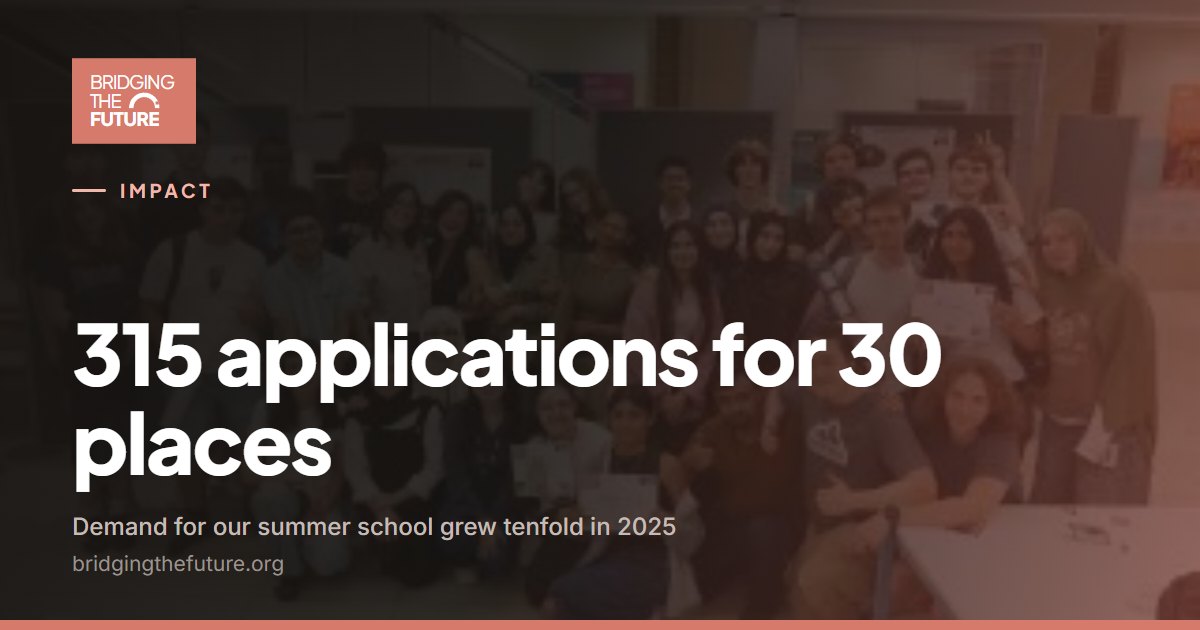
| 2025 | 315 applications |
We publish that chart with a caveat attached, and we would rather publish it with the caveat than not at all: the intermediate years are drawn from our own internal records and should be read as a trend rather than as audited statistics. The 2025 figure — 315 applications for 30 places — is exact, and it is the number that has changed how we think about our own size.
Ten applicants per place is not a compliment. It is a measurement of how little else exists.
Barrier five: nobody’s job
The most consequential barrier is the one that appears in no policy document, because it is an absence rather than a rule.
In a well-resourced school, a sixteen-year-old thinking about university has a form tutor, a careers lead, a head of sixth form, and — statistically — a parent who has been to university. Each of them holds a piece of the map. Together they answer questions the student does not yet know to ask: which A-levels close which doors, what a personal statement is for, when the UCAS deadline falls, what a foundation year is and who it is for.
A student in the vacuum often has a social worker with a caseload of thirty, a college tutor who sees them for four hours a week, and no one at all who has been through a UK university application. The information is public. It is also, in practice, invisible.
I recognise that disadvantaged young people, including refugees, will likely be the first in their family to go to university, and so seeking advice about higher education — or even having a casual conversation about the higher education experience — is not very accessible to them outside of the school setting. Christina, PhD student in Electronic & Electrical Engineering, UCL, and BTF mentor
This is the barrier that mentoring is unusually good at removing, and it is why our second programme exists at all. It costs nothing to tell someone that a foundation year exists. It is worth an enormous amount to hear it from someone who did one.
What actually closes the gap
The five barriers are not equally tractable. Two of them — placement delay and the shape of the post-16 qualification system — are policy problems that a small charity cannot fix. The other three are addressable directly, and the evidence from our own programmes and from the wider sector points the same way.
1. Teach the register, not just the language
Separating English for Science from general English is the single change that our teaching volunteers rate most highly. In our summer school the morning is language, grouped by level so that a student is neither lost nor bored, and the afternoon is practical science with the vocabulary already in hand.
The effect students report is not primarily about vocabulary. It is about permission:
Even though I thought my English was enough, I still learned new scientific terms, which improved my vocabulary. As I was preparing my academic poster on quantum computing, I took great care to paraphrase correctly and reference any sources I used, which are some of the most important skills a university student needs. A student who went on to UCL’s Undergraduate Preparatory Certificate
2. Put the young person in the building
There is a category of knowledge that cannot be transmitted in a leaflet: what a university actually feels like. Whether the people there look like you. Whether you would be allowed to touch the equipment.
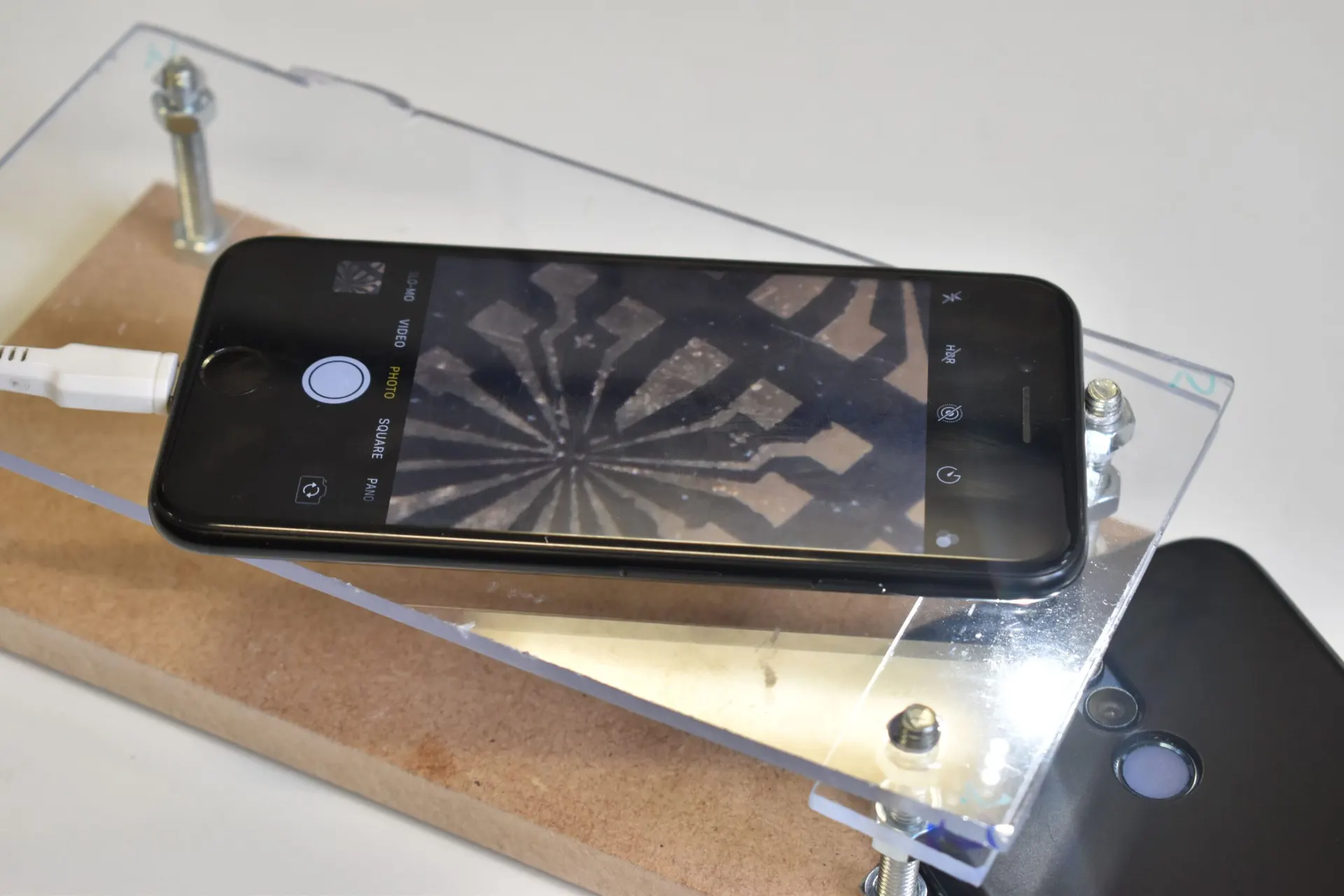
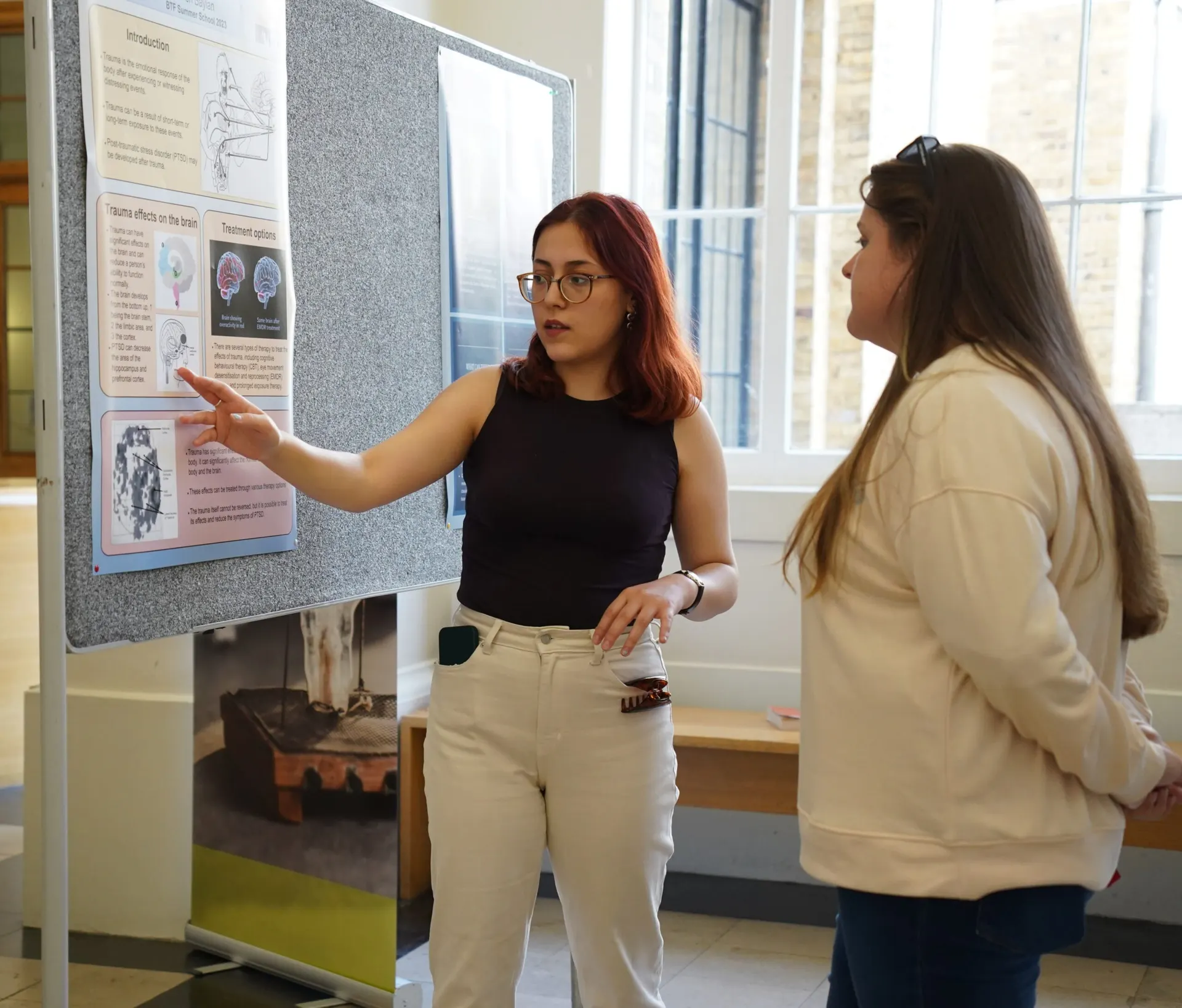
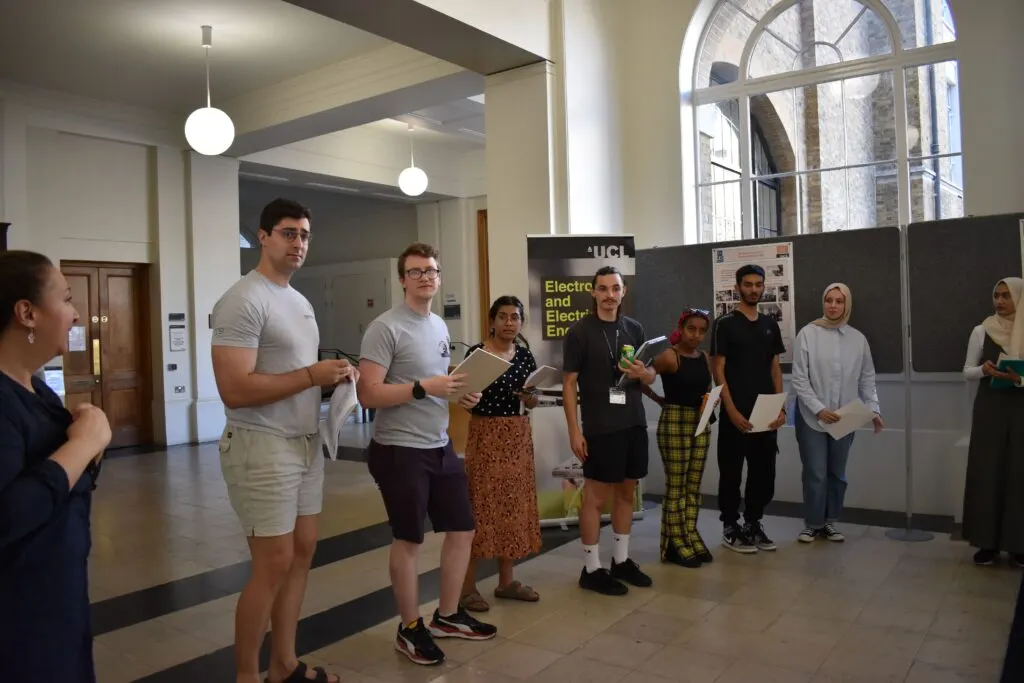
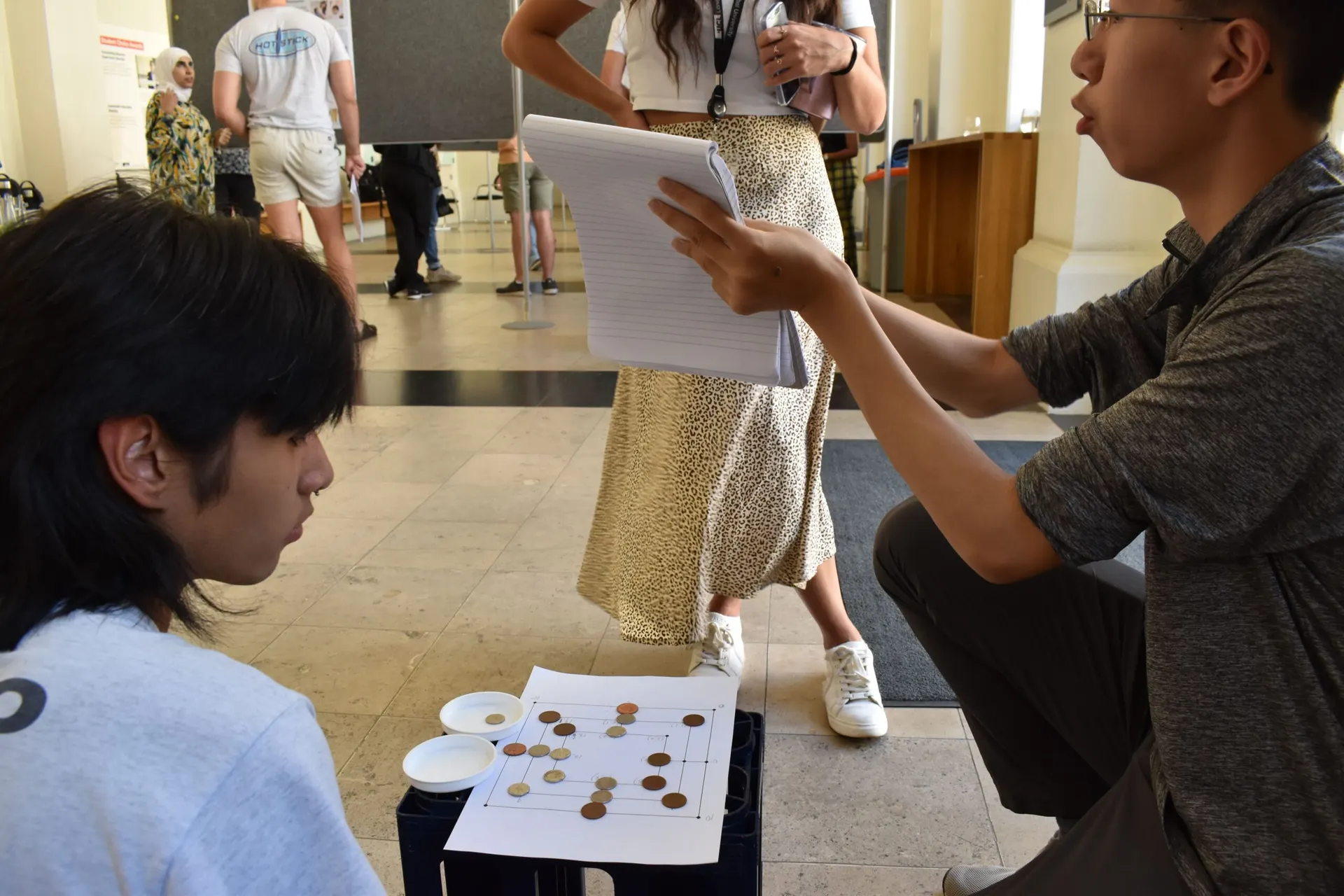
Our summer school runs inside the UCL Department of Physics & Astronomy, in real teaching labs, with researchers from the London Centre for Nanotechnology and the department’s own staff and students. The students build a microscope, extract DNA from fruit, programme a robot, and present an academic poster in the North Cloisters to passing academics who ask them real questions.
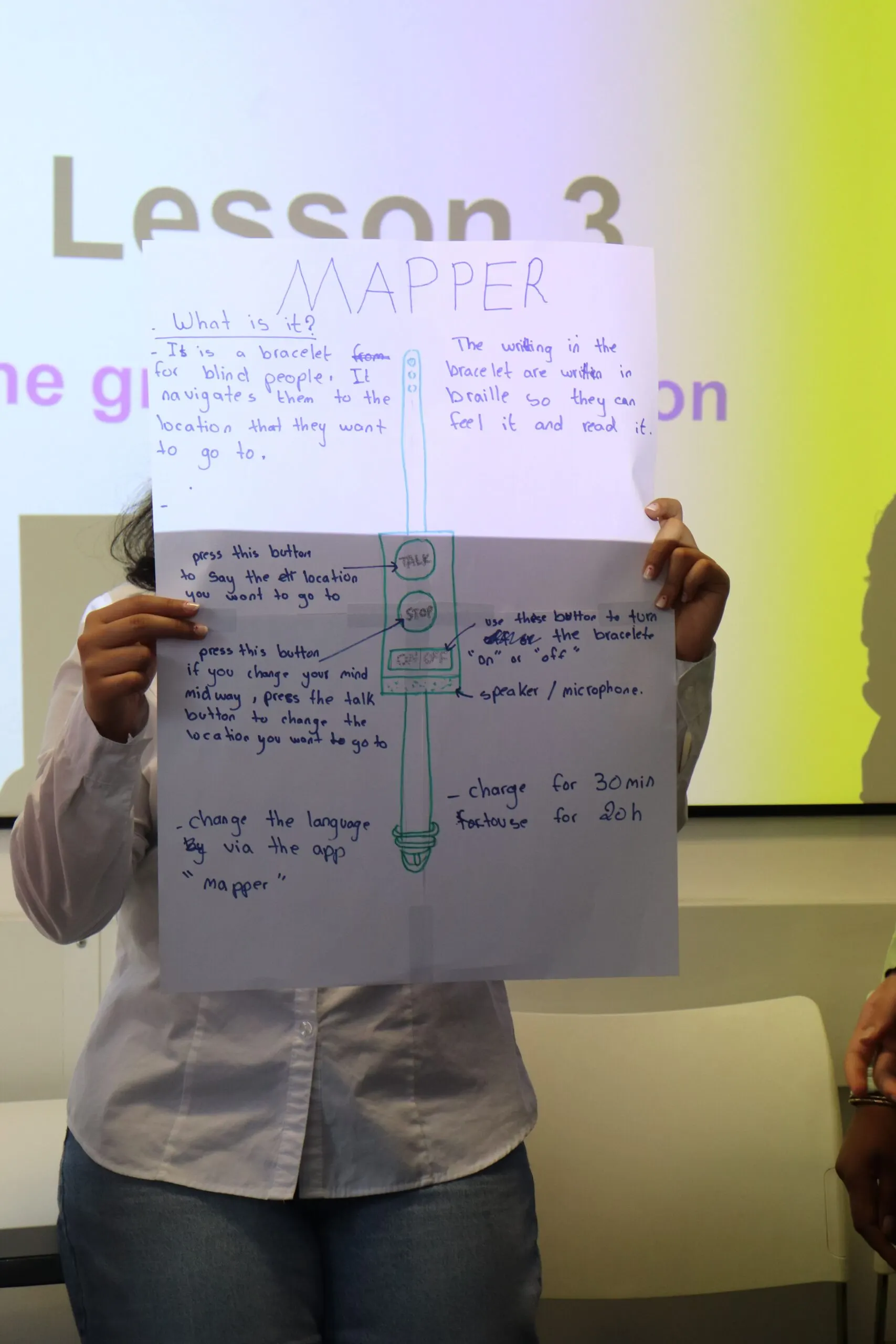
One student described the last day of the fortnight as the first time in her life she had stood in front of people explaining a topic she had never heard of before, and said it built her confidence. She won a prize for it. She now wants to study science.
3. Give them one adult with time
Mentoring is the cheapest of the three interventions and, per hour, probably the most powerful — because it addresses the fifth barrier, which no curriculum can reach.
| Barrier | Summer school | Online mentoring | Policy change |
|---|---|---|---|
| Delay in school placement | — | — | Required |
| Academic English register | Directly addressed | Directly addressed | Funding change would help |
| Subject content gaps | Partly | Directly addressed | — |
| The clock | Partly — an intensive fortnight | Partly — sustained over six months | Required |
| No one to ask | Partly | Directly addressed | — |
Our mentoring scheme runs from October to March, pairing each student with a volunteer matched on subject need. Sessions cover homework and coursework, but also the things nobody else is telling them: how to structure a personal statement, what an admissions interview is like, which universities offer sanctuary scholarships, what a foundation year does.
Since 2022 we have supported 32 students this way, through more than 250 hours of volunteer mentoring. Those are small numbers. They are also, for the students concerned, the difference between an application and no application.
Three things that would change the picture at scale
We are a volunteer-run charity with an annual intake of thirty. We are not in a position to fix a national system, and it would be dishonest to imply otherwise. But eight years of watching the same five barriers produce the same outcome does give a view on what would move the needle.
Fund academic English separately from general ESOL. The distinction is not academic pedantry; it is the difference between a young person who can order a coffee and one who can sit a science exam. At present the funding system barely recognises that the second thing exists.
Make the twenty-day placement target enforceable, and measure it publicly by region. A target that no region meets and that carries no consequence is not a target; it is an aspiration. Publishing regional performance would at least make the failure visible.
Create a designated post-16 route for late arrivals. The current options — sit GCSEs you were not taught for, or take a language course that leads nowhere — are both bad. A one-year intensive bridging qualification, recognised by colleges and universities, would give the vacuum a floor. Foundation-year routes such as UCL’s Undergraduate Preparatory Certificate, and the sanctuary scholarships attached to them, prove the model works; there are simply nowhere near enough places.
What the numbers do not show
It would be neat to end with an outcome statistic — x per cent of our students progressed to higher education — and we do not have one we would stand behind. We are a small charity with thirty places a year, our alumni are scattered across colleges and universities and jobs, and following them properly would cost money we would rather spend on the programme. Any figure we produced would be a survivorship estimate dressed as evidence.
What we do have is the observable stuff. Applications rising to ten per place. Students returning as volunteers — several of our current team first came to us as participants, including undergraduates now studying physics, mathematics, neuroscience and electrical engineering at UCL. Mentors who stay two years with the same student.
And we have the thing that is hardest to put in a chart, which is that the vacuum is not a natural feature of the landscape. It is an artefact of how the system was designed, for a population it was not designed around. Artefacts can be fixed.
Three trajectories
To make the mechanisms concrete, here are three composite trajectories. They are built from patterns we see repeatedly across our applications and mentoring pairs rather than from any single person, and no detail identifies an individual.
Trajectory A: arrives at fourteen
A boy arrives in March, aged fourteen, and is placed in Year 9 eleven weeks later. He loses most of a term but joins early enough to sit a reduced GCSE set: maths, the sciences, and one language he already speaks. English is the constraint, not ability, and he is in the system long enough for that to be visible to a teacher who can write about it.
He passes maths and two sciences, misses English, and takes it again in his first college year alongside a Level 3 BTEC in applied science. By eighteen he has a Level 3 qualification and a tutor who knows him well enough to write a reference. The route is bumpy and it works, because he arrived on the right side of the age line.
Trajectory B: arrives at sixteen
A girl arrives in September, aged sixteen. She is past compulsory school age, so no school has a duty to admit her mid-year. She is enrolled at a further education college on an ESOL course, which is the correct and only available placement.
The ESOL course is well taught. She is fluent enough by summer to hold a conversation about almost anything — and she has no GCSEs, no Level 2 in maths or English, and therefore no route onto a Level 3 course. The college offers her ESOL at the next level. She takes it, because the alternative is nothing.
This is the vacuum in its purest form: a year of genuine progress that leads nowhere, because the qualification the system gates on was never on offer.
Two things break the loop. The first is GCSE English and maths as a post-16 student, which some colleges run and many do not advertise. The second is a foundation year or preparatory certificate at a university, which is designed for exactly this situation. Both exist. Neither is likely to be mentioned unless an adult around her knows to mention it.
Trajectory C: arrives at eighteen
A young man arrives at eighteen. There is no participation duty and no obvious institution. He is in asylum accommodation, cannot work, and has a physics education from home that would place him comfortably in a UK sixth form he is now too old for.
His realistic routes are an Access to HE Diploma, if a college will take him and he can evidence enough prior learning, or a university foundation year with a sanctuary scholarship attached. Both are reachable. Both require somebody to name them.
Common questions
Is this a problem about English, or about schooling? Both, and they are usually conflated. A student can have excellent conversational English and no qualifications; another can hold a strong school record from home and be unable to sit an exam in English. The interventions are different, which is why we separate English for Science from the science itself.
Why sixteen specifically? Because that is where compulsory schooling ends and qualification gating begins. Before sixteen, a young person is owed a school place. After sixteen, they are owed a place in “education or training” — a much weaker duty that ESOL satisfies without leading anywhere.
Do these students catch up? Some do, and the ones who do usually had one of three things: an early enough arrival, an unusually well-informed adult, or a route like a foundation year that does not require the qualifications they were never able to earn. Catching up is not primarily a function of effort. The students we meet are, if anything, working harder than their peers.
Isn’t a two-week summer school a very small intervention? Yes. It is small in duration and it is aimed precisely: at confidence, at academic English, at references and evidence, and at the experience of being inside a university before applying to one. The longer intervention is the mentoring year that follows it, and neither would work as well alone.
What about students who do not want to study STEM? Our programmes are STEM-focused because our volunteer base is drawn from UCL research groups, and we would rather do one thing properly. The barriers described here are not subject-specific; organisations such as Refugee Education UK work across the whole curriculum, and we point students their way when our programme is the wrong fit.
A note on how we use numbers
We have tried throughout to distinguish between three kinds of figure, because they carry different weight.
Published national statistics — the attainment and progression gaps — come from Department for Education sources and are linked below. They describe populations, not individuals, and they change year to year.
Sector figures — the twenty-day placement finding, the enrolment rates in our companion article — come from organisations working directly with displaced young people. They are the best available and are usually derived from freedom-of-information work or from surveys, which means their coverage varies.
Our own numbers — 133 students since 2018, 315 applications for 30 places in 2025, 250+ mentoring hours, 23 countries — come from our programme records. They are exact for the things we count, and we do not extrapolate from them. We do not, for instance, claim a progression rate, because we have never had the resources to follow our alumni properly.
Where a figure in this article is indicative rather than audited, we have said so at the point of use rather than in a footnote. We would rather be visibly cautious than quietly confident.
Figures in this article were compiled in February 2026. Third-party statistics link to their primary source in the list below; our own figures come from Bridging the Future programme records for 2018–2025. If you spot something out of date, please tell us.
Keep reading
- From 1% to 15%: the fight to get refugees into higher education — what happens after the GCSE vacuum, and the global target the UK is measured against.
- Inside a free STEM summer school — the fortnight at UCL, hour by hour.
- One hour a week — what volunteer mentoring actually involves.
- Students and mentors, in their own words — first-hand accounts from the people in our programmes.
Sources & further reading
Every third-party figure quoted above links back to its primary source. Where a statistic is our own, it comes from our programme records.
- Global Trends: Forced Displacement, UNHCR (2024)
- Refugee Education Report, UNHCR
- Children in the asylum system — statistics and briefings, Refugee Council
- Key statistics about asylum seekers and refugees in the UK, Refugee Council
- Widening participation in higher education, Department for Education, GOV.UK
- Key stage 4 performance, Department for Education, GOV.UK
- Refugee Education UK — research and reports, Refugee Education UK
- Bridging the Future programme records, 2018–2025, Bridging the Future
Spotted something out of date, or have a figure we should include? Write to contact@bridgingthefuture.org and we will correct it.