In 2019, roughly one per cent of the world’s refugees were enrolled in any form of higher education. Not one per cent of applicants. One per cent of the whole refugee population of university age.
By 2021 that figure had moved to around five per cent. It is a fivefold increase, achieved in two years, against a background of rising displacement — and it is still catastrophically low. The global average for non-refugee populations sits above forty per cent. UNHCR’s stated target, adopted across the sector, is fifteen per cent by 2030: the campaign known as 15by30.
This article is about the distance between those numbers. What the enrolment ladder actually looks like, where the rungs are missing, what the UK route involves in practice, and why a charity that runs a two-week summer school for thirty people thinks any of this is its business.
- Refugee enrolment in higher education, 2019 to 2021
- 1% → 5%Refugee enrolment in higher education, 2019 to 2021A fivefold rise, from a very low base
- The 15by30 target for 2030
- 15%The 15by30 target for 2030Adopted by UNHCR and partners across the sector
- Countries our own students have come from
- 20+Countries our own students have come from114 summer school participants across 23 countries since 2018
The ladder, and where it breaks
Refugee education is usually reported as three enrolment rates: primary, secondary, and tertiary. Reported together they describe a ladder with a very particular shape.
Refugee enrolment by education stage
Approximate global enrolment rates reported by UNHCR, alongside the 2030 tertiary target
- Primary education65%
- Secondary education41%
- Higher education (2021)5%
- Higher education — 15by30 target15%
Show the data as a table
| Category | Value |
|---|---|
| Primary education | 65% |
| Secondary education | 41% |
| Higher education (2021) | 5% |
| Higher education — 15by30 target | 15% |
Two things jump out.
The first is the size of the fall between secondary and tertiary. Between primary and secondary, enrolment drops by roughly a third — bad, but recognisable as the shape of education systems generally. Between secondary and tertiary it falls off a cliff. A refugee who completes secondary school is, on the global average, still overwhelmingly unlikely to reach university.
The second is that the 15by30 target is not ambitious in absolute terms. Fifteen per cent would still be a third of the global average for everyone else. It is ambitious only relative to where things are — which tells you something about where things are.
Why the tertiary rung is the hardest
Four mechanisms do most of the work, and they compound.
Documents
University admission runs on paper. A transcript, a certificate, a translation, sometimes an apostille. People fleeing conflict do not travel with a document wallet, and the institutions that issued those documents may no longer exist, may not answer, or may be the very authority the person fled.
Recognition frameworks exist — the Council of Europe’s European Qualifications Passport for Refugees is the best-known — but coverage is partial and awareness among admissions teams is uneven. In practice, a great many applicants are asked for something they cannot obtain, and the process ends there.
Fee status and student finance
This one is specific, technical, and decisive.
In England, eligibility for home fee status and for student finance depends on immigration status and residence, not on where you went to school. Broadly: someone recognised as a refugee, or granted humanitarian protection, is generally eligible. Someone whose asylum claim is still pending is generally not — they are usually treated as an international student for fee purposes and are not eligible for a tuition fee loan or maintenance support.
The consequence is arithmetic. An international fee for a UK science degree runs to tens of thousands of pounds per year, with no loan available and, for most people awaiting a decision, no permission to work full time to pay it. For a young person in that position the university door is not narrow. It is shut, and it stays shut until a decision arrives — which may take years, arriving after the point at which their qualifications and their momentum have expired.
| Status | Home fee status | Tuition fee loan | Maintenance support | Practical route |
|---|---|---|---|---|
| Refugee status or humanitarian protection | Generally yes | Generally yes | Generally yes | Standard UCAS application |
| Limited leave to remain (some categories) | Often, subject to residence rules | Often | Often | Standard, with evidence |
| Asylum claim pending | Generally no — assessed as international | No | No | Sanctuary scholarship, or wait |
| Refused, appeal rights exhausted | No | No | No | Very limited; specialist advice essential |
Money to live on
Even where fees are covered, living costs are not automatically solved. Maintenance loans depend on the same eligibility rules. A young person in asylum accommodation may be moved, without notice, to another city — mid-term, mid-module, with a contract they cannot break and a commute they cannot afford.
Sanctuary scholarships increasingly address this. Many UK universities now offer packages that combine a fee waiver with a bursary, and some include accommodation. The Universities of Sanctuary network keeps the most useful public list. The packages are real and they change lives; there are also, relative to demand, very few of them.
The map problem
The fourth mechanism is the one we described at length in our piece on the GCSE vacuum: nobody whose job it is to explain the system.
UCAS deadlines, personal statements, contextual offers, foundation years, the difference between an unconditional and a conditional offer, what a Russell Group university is and whether it matters. This is not secret information. It is simply distributed through a network — parents, teachers, older siblings, friends’ parents — that a newly arrived young person is not connected to.
The routes that do work
Against that, four routes have a track record. They are not equivalents; they suit different situations.
Foundation years and preparatory certificates
A foundation or preparatory year is a one-year, university-taught course that leads into an undergraduate degree. It solves several problems at once: it substitutes for missing school qualifications, it teaches academic English in the subject, and it puts the student inside the institution a year early.
UCL’s Undergraduate Preparatory Certificate is the version we know best, because our students go there. The associated Bowman Scholarship, designed by Raphaëla Armbruster — who advises our charity — launched in March 2021 and offers two students from forced-migration backgrounds a full tuition fee waiver to join the UPC, on either the Sciences and Engineering or the Humanities and Social Sciences pathway, and then progress to undergraduate study.
One of our students took exactly that route, and described the sequence in her own words:
I came to the UK in 2020 as a minor, and I had not completed high school, so I did not have a diploma. I immediately started looking for ways to continue my education, but there was no support for me, and I was neglected. I did not know what to do but I kept searching. A year later, I applied for the UPC Foundation Year at UCL, as well as the Bowman Scholarship. After passing two entrance tests, one English language assessment, and several interviews, I was awarded the scholarship and started my foundation year in 2021. A Bridging the Future student, now studying at UCL
Read that again and notice what carried her: I kept searching. The route existed. Nothing in the system led her to it.
Sanctuary scholarships
Direct scholarships for people from forced-migration backgrounds, offered by individual universities. Typically a fee waiver plus a bursary; sometimes accommodation. Competitive, and each with its own eligibility rules and deadlines — which is precisely the kind of information that a mentor can hold and a student, alone, usually cannot.
Access and bridging programmes
Shorter interventions — summer schools, Saturday clubs, subject taster days — that do not themselves confer a qualification but change what a student believes is possible, and produce the evidence and references that applications need. Ours is one of these.
Distance and connected learning
For refugees in camps and in countries with no realistic route into a domestic university, connected-learning programmes deliver accredited higher education remotely, usually through a partnership between a host university and an agency. Not a substitute for campus study, but for many people the only rung available.
What each route solves
A rough score out of 5 for how far each route addresses the four main barriers
- Foundation / preparatory year5 / 5
Qualifications, language, fee status via scholarship, and institutional belonging
- Sanctuary scholarship4 / 5
Solves money; assumes the student already has qualifications and knows to apply
- Access / summer programme3 / 5
Solves belief, evidence and references; confers no qualification
- Connected / distance learning3 / 5
Solves access where nothing else exists; weaker on networks
Show the data as a table
| Category | Value |
|---|---|
| Foundation / preparatory year | 5 / 5 |
| Sanctuary scholarship | 4 / 5 |
| Access / summer programme | 3 / 5 |
| Connected / distance learning | 3 / 5 |
Where a small charity fits
We are honest about our scale. We take thirty students a fortnight a year and mentor around a dozen more at a time. Set against a global target measured in millions, that is a rounding error.
But the ladder metaphor is useful here, because rungs are local. Nobody climbs a global average. They climb from where they are to the next reachable place, and the rung immediately above a sixteen-year-old in London is not “tertiary enrolment” — it is a person who has done it, telling them how.
That is the rung we build.
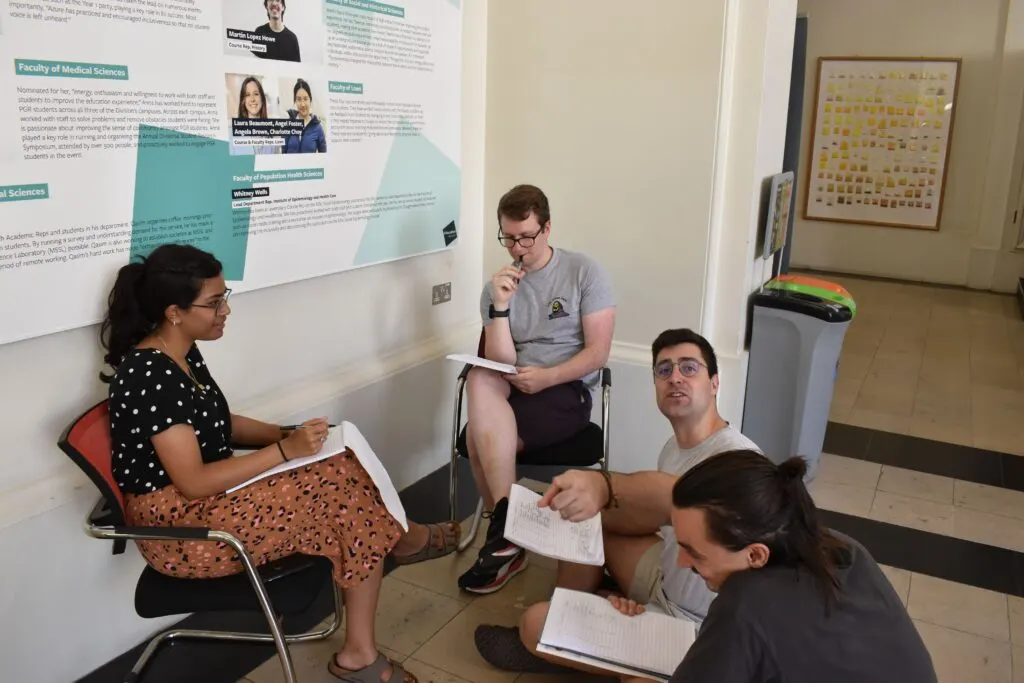
Our mentors help with homework and coursework, but the parts they mention most often are the parts that are really about the map:
Our volunteer mentors go the extra mile to help mentees pursue their goals, by helping them with CV, cover letters and university application.
And on interviews specifically, the scheme runs mock interviews for STEM degrees, including medical school admissions and Oxbridge interviews — an artefact of having a volunteer base drawn from UCL research groups, and precisely the kind of preparation that is otherwise bought.
What 15% by 2030 would actually take
Reaching fifteen per cent is not a matter of persuading more refugees to apply. It requires four separate systems to change, and they are not the same systems in every country.
Qualification recognition at scale. Not a bespoke process per applicant, but a default: an assessment route that assumes documents are missing and tests competence instead. The European Qualifications Passport for Refugees is the working proof; the gap is coverage and admissions-team awareness.
Decoupling study from immigration status. This is the hardest and the most consequential. Every year that a young person waits for a decision is a year in which the qualifications they hold decay and the momentum they had disperses. Countries that let people study while a claim is pending — at a domestic fee rate — get a materially different outcome from countries that do not.
Funded places, at a scale that matches demand. Sanctuary scholarships work. There are dozens where there would need to be thousands. This is a budget question rather than a design question, which makes it simpler to describe and harder to solve.
Guidance as infrastructure. The cheapest of the four, and the one most amenable to volunteers. Every refugee-supporting organisation, college and local authority could name one person whose job includes knowing the higher-education routes. Most cannot.
The number that stays with us
Of everything in this article, the figure we return to is not the five per cent or the fifteen per cent. It is 315.
That is how many applications we received in 2025 for thirty places on a free two-week summer school. Ten young people, for every one we could take, who found us, who filled in two forms, who arranged their August around a programme they had never attended, on the chance that it might help.
The demand is not the problem. The demand is the evidence.
What a UK application year actually looks like
The routes above are abstract until they are laid against a calendar. Here is the shape of a year for a young person aiming at a September start, with the pressure points marked.
| When | What has to happen | Why it is the pressure point |
|---|---|---|
| September | Be enrolled somewhere — college, sixth form, training | Almost everything downstream needs a tutor who can write a reference |
| October | Join a mentoring scheme; identify the qualification gap | Mentoring cycles start now; a gap identified in October is fixable, in March it is not |
| November | Confirm fee status in writing, in principle | Universities take months to answer; asking in June is asking too late |
| December–January | Shortlist three or four specific courses at named institutions | “University” is not a plan; a named course with a named deadline is |
| January | Main UCAS deadline for most undergraduate courses | Missing it does not end the year, but it narrows it |
| February–March | Sanctuary scholarship applications | Deadlines cluster here and differ by institution |
| April–May | Interviews, where a course requires them | Mock interviews make an enormous difference and are usually bought |
| June–July | Apply to summer programmes | Ours closes 5pm, 15 July 2026 |
| August | Attend the summer programme; results arrive | The fortnight generates evidence and references for the next cycle |
| September | Start, or begin the next cycle better prepared | A second cycle is common and is not a failure |
Two of those rows are worth dwelling on.
Confirming fee status in writing, early. This is the most consequential piece of administration in the whole year and the one most often left until it is urgent. A university’s admissions team will normally make a fee-status assessment on the basis of documents; that assessment can take weeks, can be queried, and determines whether the course is affordable at all. Starting the conversation in November rather than June is the difference between a resolved question and a closed door.
Mock interviews. For competitive courses — medicine, dentistry, and the Oxbridge subjects — interview performance is a large share of the decision, and interview technique is learnable. Families who can afford it buy this preparation. A student with no such network arrives cold. Our mentoring scheme runs mock interviews for STEM degrees, including medical school admissions and Oxbridge, precisely because our volunteer base can supply them for nothing.
What good practice looks like elsewhere
There is no single national model that solves this, but there are components in different places that plainly work, and it is worth naming them because they are copyable.
Assessment-based recognition instead of document-based recognition. Where a qualifications authority will assess competence directly — through examination or structured interview — rather than requiring paperwork, the documents barrier stops being decisive. The Council of Europe’s European Qualifications Passport for Refugees is the best-known instrument of this kind; the constraint on it is coverage and awareness rather than design.
Study permitted while a claim is pending, at a domestic fee rate. This is the single largest structural difference between systems that produce reasonable refugee enrolment and systems that do not. Where a young person can enrol while waiting, the waiting period becomes productive. Where they cannot, it is dead time in which qualifications age and momentum disperses.
Bridging years attached to universities rather than to colleges. A foundation year taught inside the institution the student will progress into solves the qualification gap, the academic-English gap and the belonging gap simultaneously, and it produces an internal reference. Where bridging provision sits outside the destination institution, progression is weaker.
Scholarship packages that include living costs. A fee waiver alone leaves a student unable to eat. The sanctuary packages that work best combine fees, a bursary and, increasingly, accommodation.
Guidance held by a named person. In systems where a designated adviser holds education pathways for young people in care or in the asylum system, outcomes improve — not because the adviser does anything clever, but because somebody is holding the map.
Which barrier each intervention removes
Our reading of what has to change for 15% to be reachable
- Study permitted while a claim is pending5 / 5
Removes the single biggest structural block
- Funded places at scale5 / 5
A budget question rather than a design question
- Assessment-based qualification recognition4 / 5
Removes the documents barrier
- Guidance as designated infrastructure3 / 5
Cheapest to do; largest volunteer contribution possible
Show the data as a table
| Category | Value |
|---|---|
| Study permitted while a claim is pending | 5 / 5 |
| Funded places at scale | 5 / 5 |
| Assessment-based qualification recognition | 4 / 5 |
| Guidance as designated infrastructure | 3 / 5 |
Common questions
Is 15% by 2030 realistic? On the current trajectory, globally, it is very demanding. It is also the right target, because the alternative to a demanding target is an implicit acceptance that a generation does not go to university. The useful question is not whether the global figure lands on fifteen, but whether each national system removes the specific barrier it is responsible for.
Can someone with a pending asylum claim study in the UK at all? They can generally study — the issue is the fee rate and the absence of student finance, which for most people makes an undergraduate degree unaffordable without a scholarship. Further education is a different picture and depends on age and local provision. This is exactly the kind of question that needs a specialist rather than a web page.
What is a sanctuary scholarship worth? It varies widely by institution. The stronger packages combine a full fee waiver with a maintenance bursary and sometimes accommodation; the weaker ones are a partial fee discount. Reading the detail matters, and the Universities of Sanctuary network is the practical index.
Do foundation years lead to the same degrees? Generally yes — a foundation or preparatory year is designed to feed into undergraduate study at the same institution, and often at others. It is a year longer, and for a student without school-leaving qualifications it is frequently the only route.
How can a university help? Three things, in order of usefulness: fund sanctuary scholarships that include living costs; make fee-status assessment fast and clearly documented; and lend space, staff and equipment to access programmes, which is precisely what UCL does for us and is worth more than the cash.
What we would ask of a reader
If you work in a university, the highest-value action is a scholarship that covers living costs, and a fee-status process that answers quickly.
If you work with young people, the highest-value action is naming a foundation year and a sanctuary scholarship out loud, early, to someone who has never heard those words.
If you have been through a UK university application, the highest-value action is an hour a week from October to March. That is the whole of our mentoring scheme, and it is the rung nobody else builds.
Compiled January 2026. Global enrolment figures are UNHCR’s widely reported averages and move year to year — follow the source links for the current position. UK fee and finance rules change; check GOV.UK and take specialist advice on an individual case. Our own figures come from Bridging the Future programme records, 2018–2025.
Keep reading
- The GCSE vacuum — the five barriers that stop displaced 16-year-olds before university is even in view.
- Inside a free STEM summer school — what an access programme actually consists of.
- Where the money goes — what a free place costs, line by line.
- Apply to our programme — dates, venue and the two forms.
Sources & further reading
Every third-party figure quoted above links back to its primary source. Where a statistic is our own, it comes from our programme records.
- Refugee education — 15by30 and tertiary enrolment, UNHCR
- Global Trends: Forced Displacement, UNHCR
- DAFI tertiary scholarship programme, UNHCR
- Student finance eligibility, GOV.UK
- Universities of Sanctuary, City of Sanctuary UK
- Undergraduate Preparatory Certificates, University College London
- Research and reports on refugee education, Refugee Education UK
- Bridging the Future programme records, 2018–2025, Bridging the Future
Spotted something out of date, or have a figure we should include? Write to contact@bridgingthefuture.org and we will correct it.