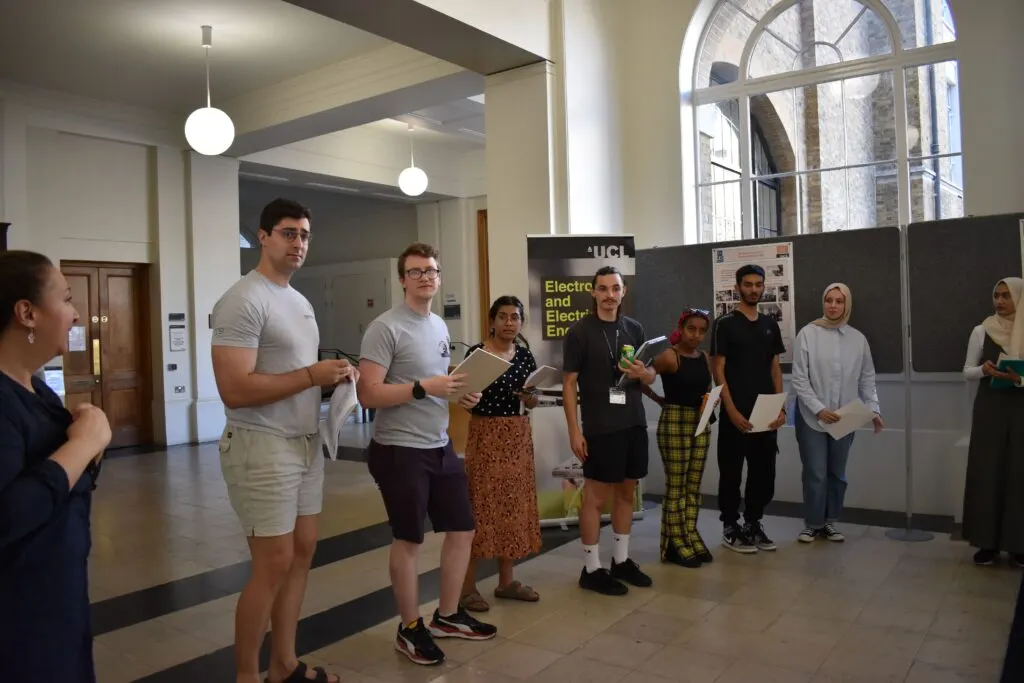
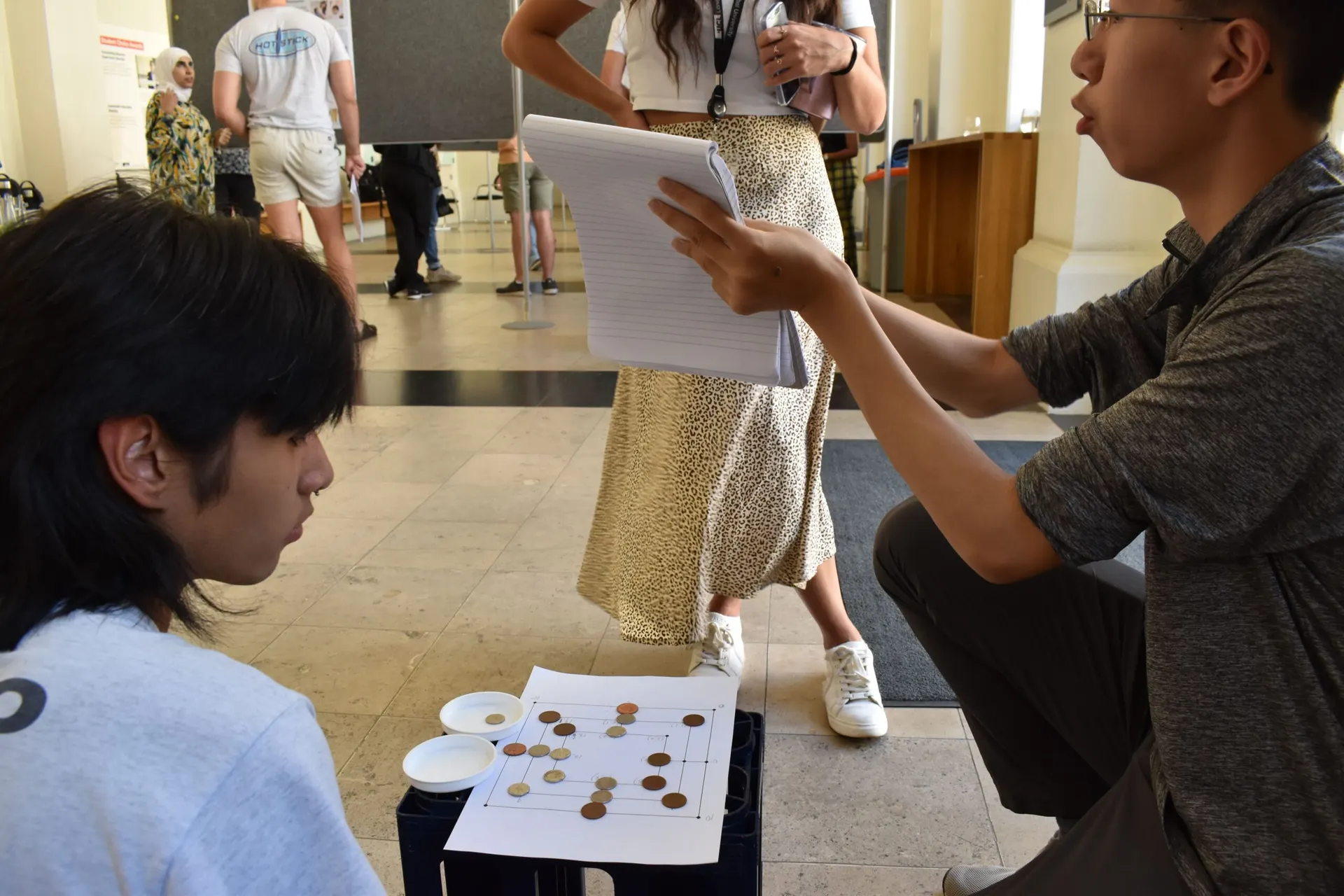
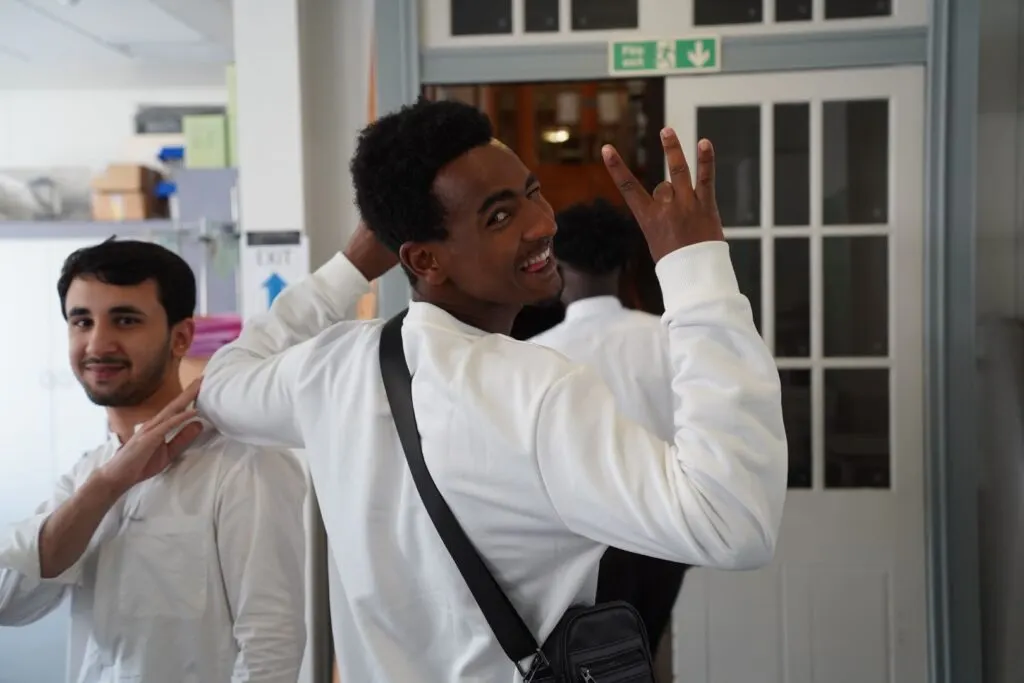
Every place on our summer school is free. Travel across TfL Zones 1–6, lunch on all eight days, every piece of equipment and material a student touches — none of it is paid for by the student or their family.
That is a deliberate design decision, and it is the single most expensive one we make. This article explains what it costs, who pays, what is donated rather than bought, and what we would do with more money. We publish it because “free programme” is a phrase that quietly implies “costless programme”, and the implication does a disservice to the people funding it.
- Raised since 2018 to deliver summer schools
- £50,000+Raised since 2018 to deliver summer schoolsAcross grants, institutional support and individual donations
- Funding from UCL in 2025
- £8,500Funding from UCL in 2025Alongside teaching space and laboratory access
- Raised through this website for summer school 2025
- £1,500Raised through this website for summer school 2025Direct donations from individuals
The registered position
Bridging the Future is a registered charity in England and Wales, number 1201227. Our record, including our filed accounts, is public on the Charity Commission register and we would encourage anyone considering a significant gift to read it there rather than take our word for anything on this page.
We have no paid staff. Every organiser, teacher, demonstrator, mentor, moderator and trustee is a volunteer. That is not a virtue signal; it is a structural fact that determines the whole cost profile below, and it comes with real risks that we discuss at the end.
What a free place is made of
The costs split into three categories that behave very differently: cash costs, donated-in-kind costs, and volunteered time.
| Cost line | Type | Why it exists |
|---|---|---|
| Student travel, TfL Zones 1–6 | Cash | Students live across Greater London; several travel from outside Zone 4 daily for eight days |
| Lunch, eight days | Cash | A 10:00–16:30 teaching day requires a meal; for some students it is the reliable one |
| Laboratory consumables | Cash | Reagents, slides, components, batteries, the fruit for the DNA extraction |
| Poster printing and materials | Cash | A3/A1 printing for the final presentations, stationery, certificates |
| Safeguarding and administration | Cash | Checks, insurance, the small unavoidable overheads of running a programme with young people |
| Teaching space and laboratory access | In kind | Real labs in the UCL Department of Physics & Astronomy |
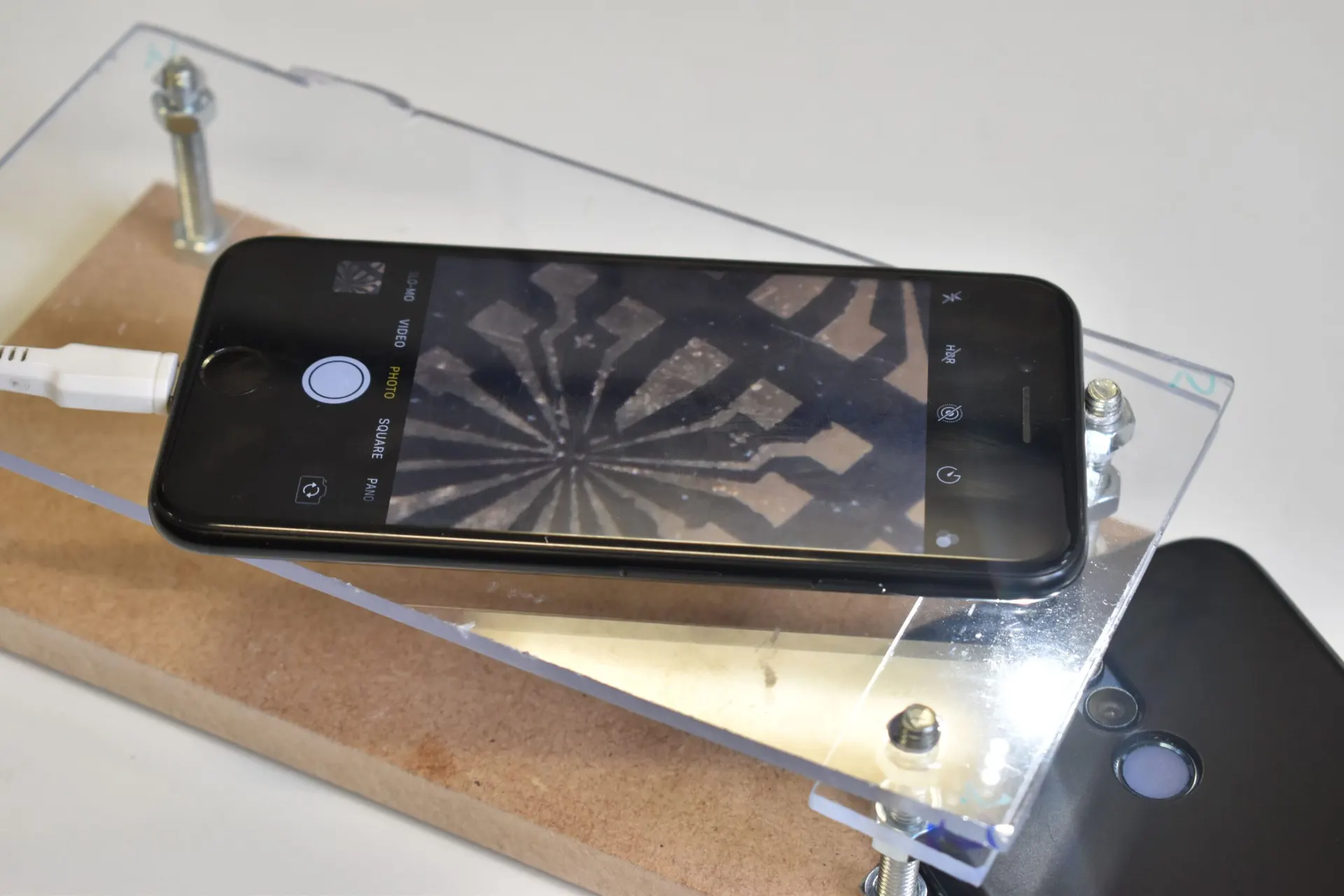
| Equipment — microscopes, optics, robots | In kind | Departmental and outreach kit, loaned for the fortnight |
| English teaching | Volunteered | Qualified teachers, unpaid |
| Science demonstrating and workshop leads | Volunteered | UCL undergraduates, postgraduates, PhD students, postdocs |
| Coordination, applications, matching | Volunteered | The operations team, unpaid |
| Governance and oversight | Volunteered | Trustees, unpaid |
Why travel is the biggest line
This surprises people, so it is worth setting out plainly.
A student living in an outer London borough travelling into Bloomsbury makes a peak-time journey across multiple zones, twice a day, for eight days. Multiply by thirty students. Then remember that many of our students are supported by an asylum support allowance that is measured in a small number of pounds per day and is intended to cover food, clothing and toiletries.
An unfunded commute is not an inconvenience for that student. It is a decisive barrier — and it is a selective barrier, because it filters out exactly the young people the programme exists for while leaving in the ones who could probably have found another opportunity.
What the cash budget goes on
Approximate share of the direct cash cost of running one summer school
- Student travel across TfL Zones 1–645%
- Lunch and refreshments, eight days30%
- Laboratory consumables and materials15%
- Printing, certificates, stationery5%
- Safeguarding, insurance, admin5%
Show the data as a table
| Category | Value |
|---|---|
| Student travel across TfL Zones 1–6 | 45% |
| Lunch and refreshments, eight days | 30% |
| Laboratory consumables and materials | 15% |
| Printing, certificates, stationery | 5% |
| Safeguarding, insurance, admin | 5% |
We publish those proportions as indicative rather than audited, and we would rather say so than present a planning estimate as a financial statement. The authoritative numbers are the ones we file.
Partial funding is worse than it sounds
An early version of the programme offered a contribution towards travel rather than covering it. It looked prudent. It was not.
A partial subsidy converts a fixed barrier into a smaller fixed barrier, which is still a barrier — and it introduces something worse: uncertainty. A young person deciding in July whether to commit their August needs to know the answer to “can I afford to attend every day?” is yes. “Probably, mostly” is not an answer anyone can plan around, and it is the students in the tightest circumstances who drop out at that point.
Covering travel completely costs more per student and produces a materially different cohort.
Where the money comes from
Three sources, with very different characteristics.
Institutional support
Our largest single contribution is from University College London, both in cash — £8,500 in 2025 — and in kind, through teaching space, laboratory access and equipment. UCL has been our long-standing partner since the programme began, and the in-kind element is worth considerably more than it appears in any cash figure.
Support has also come from organisations working in physics education and refugee support, including The Ogden Trust, whose chief executive attended one of our celebration events, and the London Centre for Nanotechnology, whose researchers make up a large share of our teaching volunteers.
Grants and trusts
Project grants, applied for annually. The most reliable per-pound source and the least reliable per-year: a grant that funds one summer school carries no promise about the next.
Individual donations
The smallest share by value and, increasingly, the most strategically important. In 2025, direct donations through this website raised around £1,500 and supported places for students alongside the UCL funding.
Two families deserve naming, because they asked us to explain why they gave:
The Bhaskar family is committed to expanding educational opportunities for underprivileged children. Having supported several education-focused charities in India, we believe that access to learning is one of the most powerful ways to break cycles of poverty and create lasting change. Bridging the Future’s mission to help young refugees rebuild their lives through education resonates strongly with our family’s values and outlook and we are proud to support their work. The Bhaskar Family
We are also grateful to the Campagnola family for their continued support.
Cumulative funds raised for summer school delivery
Since the programme began, excluding the COVID years of 2020 and 2021
Show the data as a table
| Category | Value |
|---|---|
| 2018–19 | £8,500 |
| 2022 | £18,000 |
| 2023 | £27,000 |
| 2024 | £34,000 |
| 2025 | £41,700 |
What a donation actually buys
We are wary of the “£X feeds a child for a day” style of fundraising copy, because it usually collapses under scrutiny. What follows is the honest version: these are the components of a place, not a marketing schedule.
| Roughly | Covers |
|---|---|
| A small gift | A student’s travel for one day of the fortnight |
| A medium gift | A student’s travel and lunch for several days |
| A larger gift | The consumables for one afternoon’s practical workshop, for a whole group |
| A substantial gift | A meaningful share of one student’s complete place — travel, food and materials, all eight days |
| A major gift or grant | The gap between the thirty places we offer and the demand we actually receive |
We have deliberately not put precise figures against those rows. Costs move with fares, with group sizes and with what a given year’s workshops need, and a number published in 2025 would be wrong by 2027. The donation form lets you choose an amount and, if you want, tell us what you would like it to go towards.
The number that defines our finances
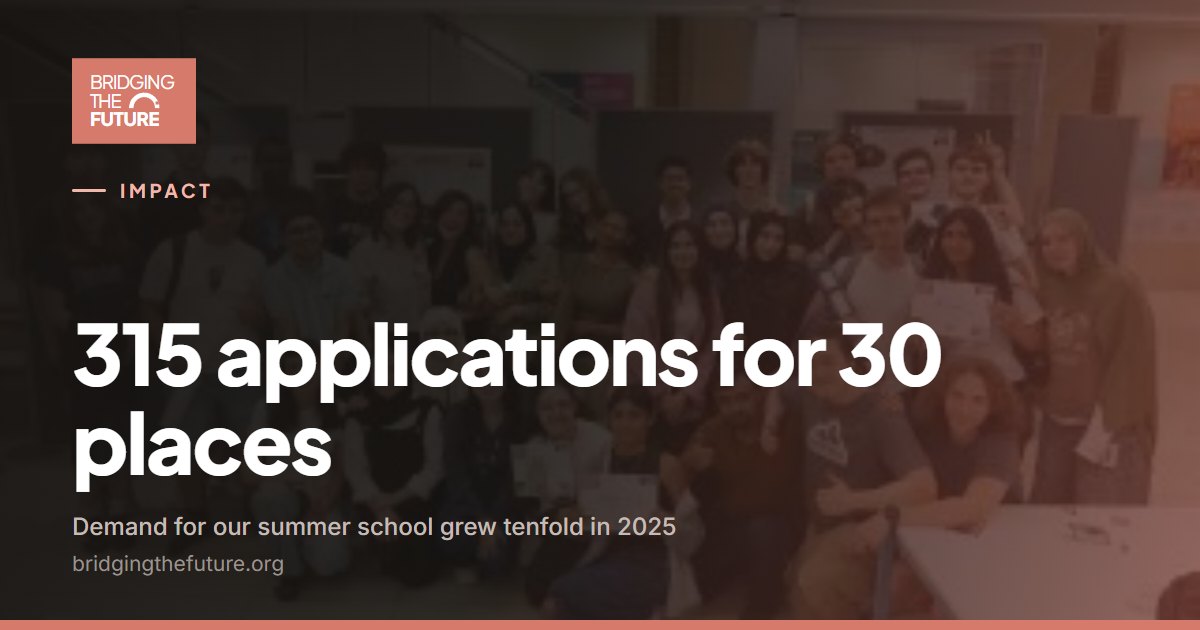
In 2025 we received 315 applications for 30 places.
That single ratio explains more about our budgeting than any other figure. We are not fundraising to sustain a programme at its current size; the programme at its current size is already turning away nine out of every ten young people who ask.
Applications against places, 2025
The gap is the entire fundraising case
- Applications received315 young people
- Places available30 young people
Show the data as a table
| Category | Value |
|---|---|
| Applications received | 315 young people |
| Places available | 30 young people |
What more money would actually change
In rough order of what we would do next.
More places on the same fortnight. The cheapest expansion per student, because the space, the volunteers and the curriculum already exist. Each additional student adds travel, food and materials — real money, but incremental rather than structural.
A second cohort, or a second location. Doubling the fortnight would double space needs, volunteer numbers and coordination. This is the step where “volunteer-run” starts to strain, and it is the honest threshold at which we would need to think about paid coordination.
Extending mentoring. The scheme currently runs October to March and supports around a dozen students at a time. Extending across the full academic year, and to more students, is largely a matter of recruiting and supporting more mentors — which is a coordination cost rather than a teaching cost.
Following our alumni properly. We do not currently know, with any rigour, what happens to our students after they leave. Finding out would take time and money that would otherwise buy places, which is why we have not done it. It is also the thing that would most improve the programme.
The risks in a volunteer-run model
An article about money that does not mention risk is marketing. Ours are these.
Key-person dependency. A programme run by volunteers depends on particular people continuing to volunteer. Our operations team changes composition every year — which brings energy, and also means institutional memory lives in documents rather than in staff.
Funding lumpiness. A single institutional contribution is a large share of the budget. Diversifying towards a broader base of individual donors is slower and less efficient per pound, and it is the right thing to do for resilience. It is a large part of why we now ask on this website at all.
Growth outrunning governance. We have four trustees and an advisor, all volunteers. There is a size at which “everyone volunteers” stops being a strength and starts being a safeguarding and financial-control risk. We would rather grow more slowly than cross that line unprepared.
The measurement gap. We know what our students say. We do not know, statistically, where they end up. We are open about that rather than filling the gap with an estimate.
What we will publish next
Two commitments, so that this page can be held against them.
First, our filed accounts remain the authoritative financial statement, and we will keep pointing at the Charity Commission register rather than asking anyone to rely on summaries.
Second, when we next raise a full year’s funding, we will publish an updated version of this article with the actual cost per place for that year, alongside the number of applications we turned away. If those two numbers move in opposite directions, we would rather say so.
How we decide what to spend on
With a small budget and more demand than capacity, almost every spending decision is a decision about who is excluded. We try to make them against three tests.
Does it remove a barrier, or improve an experience? Travel money removes a barrier: without it, a specific group of students cannot attend at all. A better lunch improves an experience. Both are worth having; only one determines who is in the room. Barrier spending comes first, always.
Would a volunteer do it for nothing, well? Teaching, demonstrating, mentoring, coordinating and governance are all done by volunteers, and done well. Travel, food and reagents cannot be. We spend cash on the things that cannot be given.
Does it survive a bad year? A commitment that must be honoured — a place we have offered a student — is different from an ambition. We would rather run a smaller programme that keeps every promise than a larger one that cannot.
Those tests produce some unglamorous outcomes. We spend nothing on advertising, because our applicants come through professionals rather than campaigns. We spend nothing on staff, because we have none. We spend a striking proportion of the budget on Oyster-card top-ups, which does not photograph well and is the most important line in the budget.
Gift Aid, and why it is worth thirty seconds
If you are a UK taxpayer, ticking the Gift Aid box adds 25p to every £1 you give, at no cost to you. HMRC pays it to us because you have already paid tax on the money.
For a charity of our size that is not a rounding error. It is the difference between funding a student’s travel for six days and funding it for eight. The declaration takes a moment on the donation form, applies to past donations in some circumstances, and is the single highest-return thirty seconds available to a UK donor.
The conditions are straightforward: you need to have paid at least as much UK Income Tax or Capital Gains Tax in the tax year as all the charities you support will reclaim on your donations. GOV.UK sets out the detail.
Monthly giving, and why we ask for it
We ask for monthly donations more prominently than one-off gifts, and it is worth explaining why, because the reason is not that monthly gifts are larger. Usually they are not.
The reason is planning. A summer school is committed to in the spring: places offered, volunteers rostered, materials ordered, travel budgeted. At the point we make those commitments we do not know what we will raise over the summer. Regular income is the only kind we can plan against, and it is the difference between offering thirty places confidently and offering twenty-five cautiously.
| Type of income | Value per pound | Predictability | What it lets us do |
|---|---|---|---|
| Restricted grant | High | Known once awarded, but one-off | Fund a specific cohort or project |
| Institutional support (cash and in-kind) | Very high | Reasonably stable, relationship-based | Underwrite the core programme |
| Regular monthly giving | High, with Gift Aid | Highest | Commit to places before the money is raised |
| One-off donations | High, with Gift Aid | Lowest | Close the gap late in the year |
| Corporate matching | High | Occasional | Doubles an individual gift at no extra cost to the donor |
If your employer runs a matched-giving scheme, that row is worth a look. Matching typically doubles a gift for the cost of filling in a form, and it is the most under-used source of income available to small charities.
How to read a small charity’s accounts
We would rather encourage scrutiny than ask for trust, so here is what to look at — for us, or for anyone else.
Find the register entry first. In England and Wales, every registered charity has a public record on the Charity Commission register, including its filed accounts and its trustees. Ours is number 1201227. If a charity is hard to find there, that is itself information.
Compare income to expenditure over several years, not one. A single year tells you almost nothing. A small charity that raises lumpy grant income will show a surplus one year and a deficit the next as it spends what it raised.
Look at what proportion is restricted. Restricted funds can only be spent on what the funder specified. A charity with high income and almost entirely restricted funds may still be unable to pay for a laptop.
Check the reserves policy. Every charity should have one, and it should say how many months of costs it aims to hold and why. Too little is fragile; a great deal too much, with no stated plan, is a fair question to ask.
Look at the trustee list and how it changes. Governance is not decoration. A board that has not changed in a decade, or that changes completely every year, both tell you something.
Be careful with “percentage spent on the cause”. It is the most cited and least useful metric in the sector. A charity with no staff will always score beautifully, and a charity that invests properly in safeguarding, evaluation and fundraising will score worse while very likely doing better work. We score well on it, and we still think it is a poor measure.
The cost of not doing it
There is a version of this article that only counts what we spend. It is worth briefly counting the other side.
A young person who does not find a route into education at seventeen does not simply pause. They enter adulthood without a school-leaving qualification, in a labour market that gates almost everything on one. The costs of that fall on them first and most heavily, and then on public services for decades.
Against that, the marginal cost of an additional place on an existing programme — a travel card, eight lunches, a share of the reagents — is very small. That asymmetry is the entire case for access work, and it is why the 315-to-30 ratio bothers us as much as it does.
We are wary of pushing that argument too hard, because it slides easily into pricing human beings, and because we cannot prove the counterfactual for any individual. But the arithmetic of the marginal place is real, and it is the reason we would rather grow the programme than polish it.
Common questions
Is my donation restricted to the summer school? Not by default. The donation form lets you direct a gift to a specific cause if you want to; unrestricted giving is more useful to us, because it can be spent on whichever part of the programme most needs it.
Do you pay anyone? No. Every organiser, teacher, mentor, moderator and trustee is a volunteer. If that changes — and at a certain size it would have to — we will say so here.
Where does the money physically sit? In the charity’s bank account, under the oversight of our trustees, including a treasurer who is a qualified actuary. Donations are processed by Donorbox on their secure platform; we never see or store card details.
Can I give something other than money? Yes, and some of the most valuable contributions are not cash. Space, equipment, expertise, and above all volunteer hours. If you have something to offer, get in touch.
Can I fund a specific student? Not directly — we do not identify individual students to donors, for obvious reasons. You can fund a number of places, and we will tell you how they were used.
How do I know this is real? Check the register. Charity number 1201227, Charity Commission for England and Wales. Everything on this page should be verifiable against what we file.
Compiled November 2025. Figures come from Bridging the Future programme and fundraising records for 2018–2025. Audited financial statements are filed with the Charity Commission for England and Wales under registration number 1201227 and take precedence over anything summarised here.
Keep reading
- Inside a free STEM summer school — what the money actually buys, day by day.
- The GCSE vacuum — why the programme is aimed at this age group.
- One hour a week — the part of our work that costs almost nothing and does a great deal.
- Donate — one-off or monthly, through our secure Donorbox form.
Sources & further reading
Every third-party figure quoted above links back to its primary source. Where a statistic is our own, it comes from our programme records.
- Search the register of charities — Bridging the Future, no. 1201227, Charity Commission for England and Wales
- Gift Aid for charities, GOV.UK
- Fares and Zones, Transport for London
- Charity reporting and accounting: the essentials, GOV.UK
- Donation platform, Donorbox
- Bridging the Future programme and fundraising records, 2018–2025, Bridging the Future
Spotted something out of date, or have a figure we should include? Write to contact@bridgingthefuture.org and we will correct it.